
In this article
- The big picture
- Why timing matters: the socialization window
- 8 to 10 weeks: settling in
- 10 to 12 weeks: puppy class and bite inhibition
- 3 to 4 months: foundation cues
- 4 to 5 months: teething and generalization
- 5 to 6 months: getting ready for adolescence
- A weekly plan at home
- The method
- Socialization checklist by category
- Daily routine for an 8–12-week-old puppy
- Common mistakes by age
- Milestone checklist at 6 months
- How to use rewards at each age
- Tools that help
Puppies change fast, and so do their training needs. What works at 9 weeks — short games, lots of sleep, gentle new experiences — is different from what a 5-month-old with adult teeth and teenage energy needs. This schedule shows what to focus on at each stage, so you teach the right things at the right time.
The big picture
| Age | Main focus | Core skills |
|---|---|---|
| 8–10 weeks | Socialization, routine | House training, crate, name, handling |
| 10–12 weeks | Puppy class, bite inhibition | Sit, hand target, trading toys |
| 3–4 months | Foundation cues | Down, come, leave it, first leash walks |
| 4–5 months | Generalization, teething | Stay, mat settle, cues in new places |
| 5–6 months | Reliability, adolescence | Loose-leash walking, recall with distractions |
Why timing matters: the socialization window
The AVSAB position statement on puppy socialization explains that the first three months are when sociability outweighs fear, making this the main window for puppies to adapt to new people, animals, places and sounds. AVSAB considers it standard of care to socialize puppies before they are fully vaccinated, because the risk of infection in well-run settings is small compared with the risk of behavior problems later. Puppy classes can start at 7–8 weeks, with at least one set of vaccines 7 days before the first class and a first deworming. Avoid dog parks and areas used by dogs of unknown health status. Details in our guide to puppy socialization.
8 to 10 weeks: settling in
- House training: take the puppy out at least every two hours and after sleeping, eating, drinking and play. See how to potty train a puppy.
- Crate: start with open-door games and meals in the crate — see crate training a puppy.
- Name game: say the name once, reward when the puppy looks at you.
- Handling: touch ears, paws and mouth for a second, then treat. It pays off at the vet and the groomer.
- Socialization: new people (gently), surfaces, household noises, car rides — always at the puppy’s pace.
10 to 12 weeks: puppy class and bite inhibition
- Enroll in a reward-based puppy class once the vaccine requirement is met.
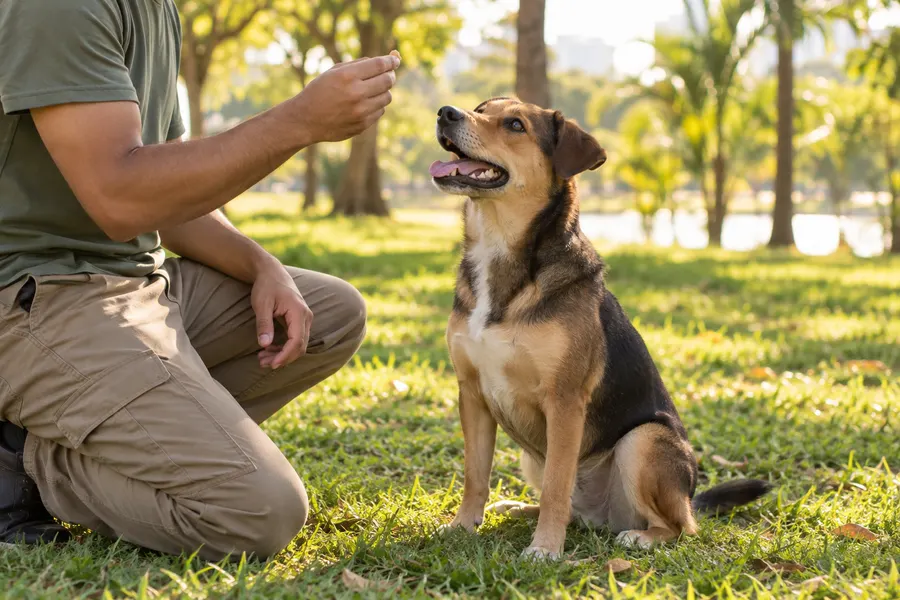
- Teach sit with a food lure, then fade the lure; see how to teach a dog to sit.
- Teach a hand target (nose to palm), useful for recall and moving the puppy without pulling.
- Handle mouthing: redirect to a toy, and pause play briefly when teeth touch skin.
- Protect sleep: young puppies need a lot of rest, and overtired puppies bite more.
3 to 4 months: foundation cues
- Down and come in the house and yard, with high-value rewards.
- Leave it: start with a treat in a closed hand.
- Leash: short walks focused on sniffing and rewarding the puppy for staying near you.
- Keep socializing: different people, friendly vaccinated adult dogs, gentle exposure to traffic and crowds from a distance.
4 to 5 months: teething and generalization
- Teething: offer frozen chews and puzzle toys; supervise and puppy-proof the house.
- Stay: add distance, duration and distraction one at a time.
- Go to mat: a settle cue for meals and visitors.
- Generalize: practice known cues in new rooms, the yard, a quiet park.
5 to 6 months: getting ready for adolescence
Many puppies seem to “forget” everything as they approach adolescence. That is normal.
- Keep sessions short and rewarding.
- Work on loose-leash walking: stop when the leash tightens, reward when the puppy returns.
- Practice recall on a long line with mild distractions.
- Keep up socialization and handling — they are not one-time tasks.
A weekly plan at home
| Day | Session ideas (3–5 minutes, 2–3 times a day) |
|---|---|
| Monday | Name game, sit, handling |
| Tuesday | Hand target, crate game, new surface |
| Wednesday | Down, leave it, car ride |
| Thursday | Come (recall game between two people), new person |
| Friday | Mat settle, leash practice |
| Saturday | Puppy class or outing |
| Sunday | Review favorites, enrichment and rest |
The method
Use rewards — food, play, praise — and avoid punishment. The AVSAB position on humane training recommends reward-based methods for all dogs, and puppies are especially sensitive to fear. Learn the principles in positive reinforcement dog training.
Socialization checklist by category
Aim for calm, positive exposure — not forced contact. Reward curiosity and let the puppy retreat.
| Category | Examples |
|---|---|
| People | Men, women, children (supervised), people with hats, beards, uniforms, wheelchairs |
| Animals | Calm vaccinated adult dogs, cats that are used to dogs |
| Sounds | Vacuum, doorbell, traffic, thunder recordings at low volume |
| Surfaces | Grass, tile, carpet, gravel, metal grates, wobbly cushions |
| Places | Car rides, a vet visit for treats only, quiet parking lots, a friend’s house |
| Handling | Ears, paws, mouth, brushing, nail clipper touches |
| Objects | Umbrellas, bikes, strollers, skateboards (from a distance) |
Daily routine for an 8–12-week-old puppy
| Time | Activity |
|---|---|
| Morning | Potty, breakfast, short play, 3-minute training, nap |
| Midday | Potty, socialization outing or new experience, nap |
| Afternoon | Potty, chew time, training game, nap |
| Evening | Potty, dinner, family time, handling practice |
| Night | Last potty trip, crate by the bed |
Young puppies sleep a lot. If your puppy becomes bitey and frantic, it often needs a nap, not more play.
Common mistakes by age
- 8–12 weeks: keeping the puppy isolated until all vaccines are done, missing the socialization window.
- 3–4 months: long training sessions and repeating cues the puppy does not know yet.
- 4–6 months: giving full house freedom too soon; teething puppies chew everything.
- 5–6 months and beyond: assuming adolescence means the puppy is “stubborn” and switching to punishment.
Milestone checklist at 6 months
- Responds to its name most of the time
- Sits and lies down on cue in familiar places
- Comes when called indoors and in the yard
- Walks on a loose leash for short stretches
- Accepts handling of paws, ears and mouth
- Rests calmly in a crate or on a mat
- Mostly house trained
- Copes calmly with everyday sounds and visitors
If several boxes are empty, that is normal — simply keep working at the puppy’s pace. If your puppy shows persistent fear, growling or snapping, talk to your veterinarian early.
How to use rewards at each age
Young puppies work best for small, soft food rewards; older puppies may love toys and play as well. Use the most valuable rewards for the hardest tasks, such as recall outdoors or calm behavior around other dogs, and everyday kibble for easy repetitions at home. As skills become reliable, reward some repetitions with praise or life rewards (going outside, a sniff, a game) instead of food.
Tools that help
The 30-Day Puppy Training Plan turns this schedule into four printable weekly tables with a socialization checklist and house-training log. For extra mental exercise as the puppy grows, Brain Training for Dogs, below, offers reward-based games. Breed matters too: see our German Shepherd training guide. More in the dog training guide.
 Guide · $15The 30-Day Puppy Training Plan
 Recommended online courseTrain your dog with reward-based gamesGuide · $15The 30-Day Puppy Training PlanDay-by-day 30-day plan with reward-based training, socialization, house training and printable routines and trackers.Buy now →
Frequently asked questions
When should I start training my puppy?
Right away. Puppies learn from the first day home, usually around 8 weeks. Start with short, fun sessions on name response, house training and handling, and begin socialization immediately, because the window when puppies accept new things most easily closes at around three months.
Can my puppy go to classes before all vaccines?
AVSAB says puppies can start socialization classes as early as 7 to 8 weeks if they have had at least one set of vaccines at least 7 days before the first class and a first deworming, and stay up to date. Avoid dog parks and areas used by dogs of unknown health status.
How long should puppy training sessions be?
Short — about 3 to 5 minutes for young puppies, a few times a day. Stop while the puppy is still engaged. Several brief sessions teach more than one long one.
When should a puppy know basic commands?
Many puppies learn sit, down and their name within a few weeks and can respond in a quiet room by about 3 to 4 months. Reliability around distractions takes longer and keeps improving well past six months.
How do I stop puppy biting?
Mouthing is normal. Give plenty of chew toys, redirect teeth from skin to toys, pause play for a few seconds when teeth touch skin and make sure the puppy gets enough sleep, since overtired puppies bite more. Never hit or hold the mouth shut.
What should a 6-month-old puppy know?
Typically house training (with rare accidents), crate comfort, name response, sit, down, come in easy settings, walking on a loose leash part of the time, settling on a mat, accepting handling and calm behavior around everyday sights and sounds.
Sources
- Position Statement on Puppy Socialization — AVSAB: ventana de los tres primeros meses y clases desde las 7–8 semanas↗
- Position Statement on Humane Dog Training (2021) — AVSAB: métodos basados en recompensa y riesgos de los métodos aversivos↗
- How to potty train your dog or puppy↗