
In this article
- What reactivity is (and is not)
- Step 0: see your veterinarian
- Step 1: map triggers and threshold
- Step 2: manage every walk
- Step 3: counterconditioning and desensitization
- Step 4: teach alternative behaviors
- Step 5: progress slowly
- What to avoid
- When to get professional help
- Reading your dog’s body language
- Sample week of reactive dog training
- Equipment for reactive dogs
- Common mistakes
- Tracking progress
- Keep building skills
Few things make walks more stressful than a dog that explodes at the end of the leash. The good news: leash reactivity is one of the most common behavior problems trainers see, and there is a well-established, humane way to improve it. This plan explains what is going on in your dog’s head and gives you exercises to do every day.
What reactivity is (and is not)
A reactive dog overreacts to a specific trigger — other dogs, strangers, bikes, skateboards — with barking, lunging, growling or spinning. It often looks like aggression, and it can escalate to aggression, but in most cases the underlying emotion is fear, frustration (a social dog who cannot reach another dog) or overexcitement. The Merck Veterinary Manual notes that most aggression-related behavior is an attempt by the dog to increase distance from something it finds threatening, and that fear is the most common driver.
| Type | What it looks like | What drives it |
|---|---|---|
| Fear-based | Stiff body, barking while backing up, hackles, tucked tail | The dog wants the trigger to go away |
| Frustration-based | Whining, pulling toward the trigger, then barking | The dog wants to reach the trigger and cannot |
| Excitement | Bouncing, high-pitched barks, spinning | Overarousal |
Whatever the type, the plan below works on the emotion.
Step 0: see your veterinarian
Pain, itchy skin, vision or hearing loss and thyroid disease can all lower a dog’s tolerance. Behavior that started suddenly, or in an older dog, especially deserves a vet visit. Your vet can also discuss whether anti-anxiety medication would help a very fearful dog learn.
Step 1: map triggers and threshold
For one week, write down every reaction: what the trigger was, how far away, and what happened right before. You are looking for the threshold — the distance at which your dog notices the trigger but can still take food, sniff and respond to you. Under threshold, learning happens. Over threshold, the dog is in survival mode and cannot learn.
Step 2: manage every walk
You cannot change emotions while the dog rehearses the reaction daily. Management means:
- walking at quiet times and in quieter places;
- using a well-fitted harness instead of a collar that presses on the throat;
- crossing the street, stepping behind a parked car or turning around early;
- skipping walks on bad days and doing brain games or sniff work at home instead.
Step 3: counterconditioning and desensitization
This is the core of reactive dog training:
- At a distance below threshold, the moment your dog sees the trigger, start feeding small, high-value treats (chicken, cheese).
- Keep feeding while the trigger is in view.
- When the trigger disappears, the food stops.
- Repeat until your dog sees a dog and turns to you expecting food — that is the emotional shift.
- Only then reduce the distance a little.
The order matters: trigger first, then food. If food appears first, the dog learns that treats predict scary things.
Step 4: teach alternative behaviors
Practice these at home and in quiet places before using them near triggers:
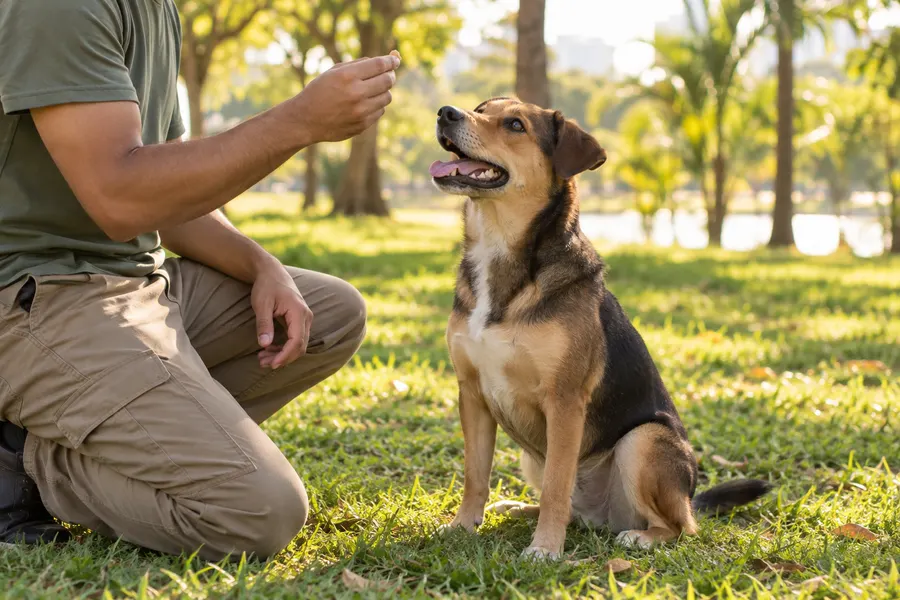
- Look at that: the dog looks at the trigger, you mark (“yes!”) and treat.
- Hand target: the dog touches your palm with its nose — a quick way to move them.
- Emergency U-turn: a happy cue (“let’s go!”), turn, and reward a few steps later.
- Find it: scatter treats on the ground to lower arousal and create sniffing.
Step 5: progress slowly
Shrink the distance only when your dog is relaxed at the current one for several sessions. After a reaction, do not punish; calmly create distance and end with an easy success. Progress is rarely a straight line.
What to avoid
The AVSAB position statement on humane dog training recommends against leash jerks, prong, choke and shock collars and intimidation, which are associated with increased fear, stress and aggression. A dog that is punished for barking may stop barking and go straight to biting, because its warning has been suppressed. Flooding — forcing the dog close to the trigger “until it gets used to it” — is another common mistake.
When to get professional help
Look for a trainer who uses reward-based methods and can explain desensitization in plain language. The AVSAB guide on choosing a trainer and our article on how to choose a dog trainer list what to ask. If there has been a bite, or the reactivity is severe, ask your veterinarian for a referral to a veterinary behaviorist. See also aggressive dog training: what works.
Reading your dog’s body language
Catching early signs lets you create distance before your dog goes over threshold.
| Stage | What you may see | What to do |
|---|---|---|
| Relaxed | Loose body, soft eyes, sniffing | Continue, reward check-ins |
| Alert | Ears forward, head up, sniffing stops | Start feeding as soon as the trigger is seen |
| Concerned | Lip licking, yawning, whale eye, slower movement | Increase distance |
| Over threshold | Stiff body, hard stare, raised hackles, barking, lunging | Calm U-turn and leave |
Sample week of reactive dog training
| Day | Session | Goal |
|---|---|---|
| Monday | Look at that with a calm dog far away | Positive association |
| Tuesday | Home practice: U-turn, hand target, find it | Strong alternatives |
| Wednesday | Decompression walk in a quiet area | Lower overall stress |
| Thursday | Repeat Monday at the same distance | Consistency |
| Friday | Parking-lot setup: watch people from the car | New trigger, safe distance |
| Saturday | Sniff games and rest | Recovery |
| Sunday | Short session at slightly shorter distance if Thursday went well | Gradual progress |
Decompression days matter. Stress hormones can stay elevated after a big reaction, and a stressed dog reacts more easily.
Equipment for reactive dogs
- Well-fitted harness: reduces pressure on the neck when the dog lunges.
- Six-foot leash: gives control; retractable leashes make it harder to create distance.
- Treat pouch: fast access to food matters with this method.
- Basket muzzle (if there is any bite risk): train it with treats first so the dog accepts it.
- Visual signals for others: a vest or leash sleeve saying “needs space” can help.
Common mistakes
- Working too close. If your dog cannot take food, you are over threshold.
- Food before the trigger. The order must be trigger, then food.
- Tight leash. Tension tells your dog something is wrong. Keep the leash loose when you can.
- Dog parks and on-leash greetings. They often set reactive dogs up to fail.
- Inconsistency. A few great sessions cannot outweigh daily reactions on uncontrolled walks.
- Expecting a straight line. Bad days happen; go back a step and keep going.
Tracking progress
Record date, trigger, distance, your dog’s response and recovery time. Over weeks you should see reactions happen at shorter distances, less intensely, and with faster recovery. Those three numbers are better measures of progress than “did my dog bark today”.
Keep building skills
Reactive dogs benefit from calm, focused work at home: impulse control games, nose work and relaxation on a mat. Brain Training for Dogs, below, is an online course of reward-based games that fits well with a reactivity plan, though it does not replace a professional for serious cases. For puppies, prevention starts with socialization, and The 30-Day Puppy Training Plan includes a socialization checklist. More in the dog training guide.
 Guide · $15The 30-Day Puppy Training Plan
 Recommended online courseTrain your dog with reward-based gamesGuide · $15The 30-Day Puppy Training PlanDay-by-day 30-day plan with reward-based training, socialization, house training and printable routines and trackers.Buy now →
Frequently asked questions
What is a reactive dog?
A dog that responds with more intensity than the situation calls for — barking, lunging, growling or spinning — to specific triggers such as other dogs, people, bikes or cars, most often on leash. Reactivity is usually driven by fear, frustration or overexcitement rather than a desire to attack.
Can a reactive dog be cured?
Many reactive dogs improve a lot, and some become calm around their triggers, but progress is gradual and depends on the cause, the dog's history and your consistency. Think in terms of management plus steady improvement, not a quick fix.
Why is my dog reactive on leash but fine off leash?
A leash removes the option to move away or greet naturally. Fearful dogs that cannot escape may bark and lunge to make the trigger leave, and frustrated, social dogs may react because they cannot reach the other dog. Tension on the leash can make both worse.
Should I correct my dog when it lunges?
No. Corrections may stop the behavior in the moment, but they add discomfort to the sight of the trigger, which can deepen fear and suppress warning signals. AVSAB recommends reward-based methods for all behavior modification.
How long does reactive dog training take?
Expect weeks to see change and months for solid progress. Short daily sessions at the right distance work better than occasional long sessions close to triggers.
When should I see a veterinary behaviorist?
If your dog has bitten or tried to bite, if reactivity is getting worse despite training, or if the dog seems anxious much of the day. A veterinarian can check for pain and discuss medication, and a veterinary behaviorist can build a treatment plan.
Sources
- Position Statement on Humane Dog Training (2021) — AVSAB: métodos basados en recompensa y riesgos de los métodos aversivos↗
- Behavior Problems in Dogs — Merck Veterinary Manual (pet owner version)↗
- Aggression in dogs↗