
In this article
Why start with sit
Sit is easy to teach, easy to reward and useful every day: at the door, before meals, at the curb, when greeting people. It is also a great first lesson in how reward-based training works, the approach recommended by the RSPCA and the AVSAB.
What you need
- Pea-sized soft treats your dog loves
- A quiet room with no distractions
- A marker: a clicker or a short word like “yes”
- Two to five minutes
Step-by-step
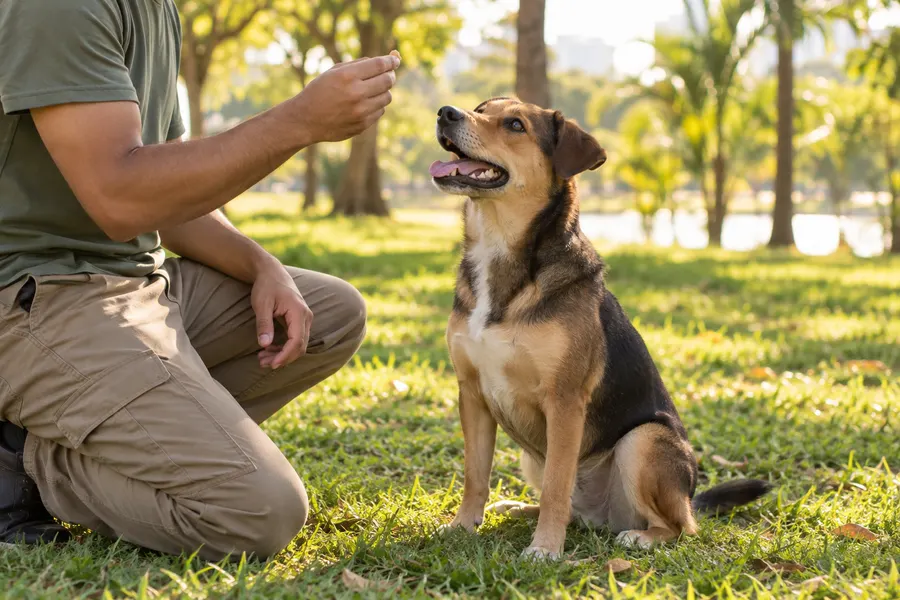
- Lure the sit. Hold a treat right at the dog’s nose. Move it slowly up and back over the head, toward the ears. As the nose follows the treat up, the rear naturally goes down.
- Mark and reward. The instant the rear touches the floor, say “yes” (or click) and give the treat. Timing matters more than anything else.
- Repeat. Do five to ten repetitions, then take a break. Toss a treat a step away to get the dog standing again for the next rep.
- Fade the lure. After several successes, make the same hand movement with no treat in that hand. When the dog sits, mark and reward from your other hand or a pouch. This prevents the dog from only sitting when it sees food.
- Add the cue. Now say “sit” once, just before the hand signal. Over many repetitions, the word comes to predict the behavior, and you can make the hand signal smaller.
- Build the three Ds. Add duration, distance and distractions, one at a time.
Building the three Ds
| D | How to practice | Tip |
|---|---|---|
| Duration | Wait one second before marking, then two, then five | Reward while the dog is still sitting |
| Distance | Take one step back, then return to reward | Go back to the dog to deliver the treat |
| Distractions | Practice in the yard, then on a quiet street, then near other dogs | Use higher-value treats as things get harder |
Change only one D at a time. If you add distance, shorten duration and practice somewhere quiet.
Capturing: the no-lure alternative
Some dogs, especially those that follow hands too eagerly, learn faster by capturing. Stand quietly with treats ready. Whenever the dog happens to sit, mark and reward. Within a few sessions most dogs start sitting on purpose to “make” you reward. Then add the cue as above.
Troubleshooting
- The dog jumps for the treat. Your hand is too high. Keep it just above the nose and move more slowly.
- The dog backs up instead of sitting. Practice with the dog’s back against a wall or in a corner.
- The dog sits but pops up immediately. Reward faster at first, then build duration slowly.
- The dog ignores the cue. You may be saying the word too often or after the hand signal. Say it once, before the signal.
- The dog is not interested. Try better treats, train before meals, and keep it short.
Things to avoid
- Pushing down on the dog’s rear or hips.
- Repeating “sit” over and over.
- Scolding for mistakes; just make the next repetition easier.
- Long sessions that end with a bored or frustrated dog.
Using sit in daily life
Once sit is reliable, use it as a polite way for your dog to ask for things: sit before the food bowl goes down, before the leash goes on, before the door opens, before greeting a visitor. Each of these is a free, natural reward that keeps the behavior strong without extra treats.
Older dogs and dogs with pain
Older dogs and dogs with hip or back problems may find sitting uncomfortable. If your dog seems reluctant, sits crooked or gets up slowly, ask your veterinarian to check for pain, and teach a stand or down instead.
Next: positive reinforcement basics and puppy socialization.
 Guide · $15The 30-Day Puppy Training Plan
 Recommended online courseTrain your dog with reward-based gamesGuide · $15The 30-Day Puppy Training PlanDay-by-day 30-day plan with reward-based training, socialization, house training and printable routines and trackers.Buy now →
Frequently asked questions
Should I push my dog's rear down to teach sit?
No. Pushing can be uncomfortable, especially for dogs with joint pain, and teaches the dog to resist rather than to offer the behavior. Luring with a treat or rewarding a sit the dog offers on its own works better.
How long does it take to teach a dog to sit?
Many dogs learn the basic sit in a few short sessions. Making it reliable in new places and around distractions takes weeks of practice, rewarding often at first and then less frequently.
My dog sits at home but not on walks. Why?
Dogs do not generalize easily. A sit learned in the kitchen needs to be practiced in the yard, on quiet streets and then in busier places, making it easier and rewarding more each time the environment gets harder.