Topic
Veterinary assistant: what the job is and how to start
Quick answer
A veterinary assistant supports the clinic team with non-clinical work: restraining animals, cleaning and stocking exam rooms, feeding and monitoring patients and helping clients. Assistants do not diagnose, prescribe or perform surgery. In the U.S. it is an entry-level job: the BLS lists a high school diploma as the typical requirement and a median pay of $38,150 a year (May 2025). A course with hands-on hours helps you land the first job.
Articles on this topic
 Buying guideIs a veterinary assistant course worth it? An honest lookWhen a veterinary assistant course pays off, when it does not, and a checklist to judge any program before you pay — externship, scope, cost and promises.Read article
 Buying guideOnline vet assistant programs: how to pick a legit oneHow online vet assistant programs work, what NAVTA approval means, what to check before you pay and how a certificate fits into getting hired.Read article
 Buying guideVeterinary assistant vs. vet tech: key differencesEducation, credentials, duties and pay compared — how a veterinary assistant differs from a veterinary technician and which path fits you.Read article
 Buying guideVeterinary technician online courses: are they legit?Which online vet tech degrees lead to the VTNE and a state credential, how distance programs handle clinical skills, and the warning signs to avoid.Read article
 Question answeredHow to become a veterinary assistant: a step-by-step pathRequirements, training options, certification and job-search tips for becoming a veterinary assistant in the U.S., from high school to first job.Read article
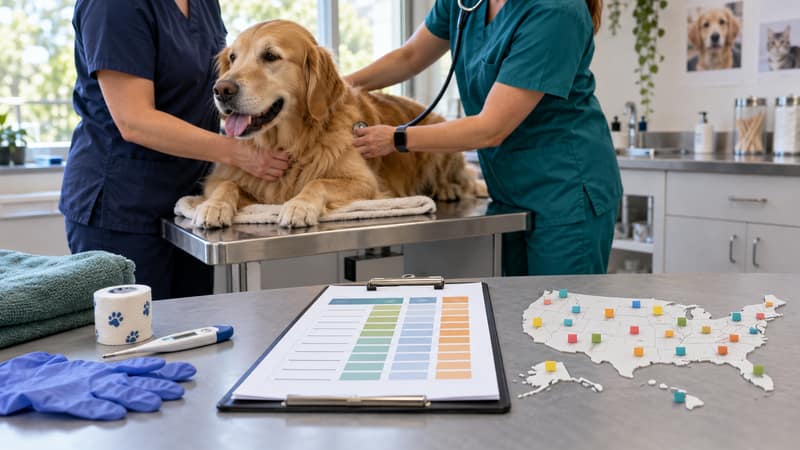 Question answeredVet assistant salary by state (BLS May 2025 data)Median vet assistant and vet tech pay in all 50 states and DC from BLS May 2025 wage data, plus why pay differs and how to compare offers.Read article
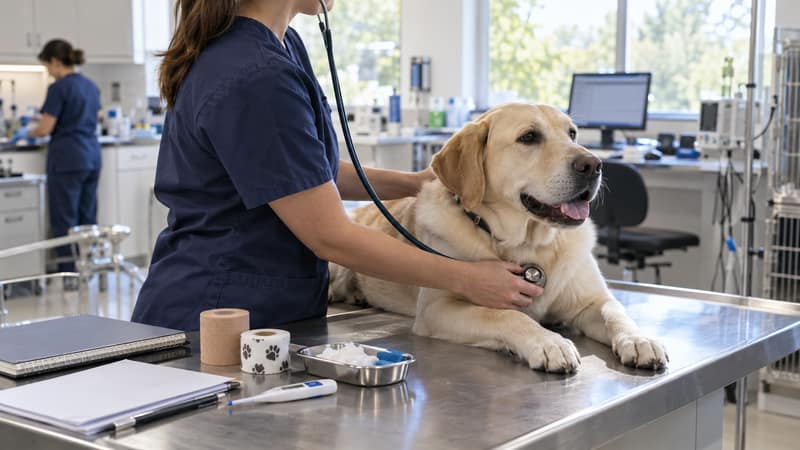 Question answeredVet tech certification: requirements and the VTNE explainedHow veterinary technician certification works in the U.S. — accredited programs, the VTNE, state credentials (RVT, LVT, CVT) and what it pays.Read article
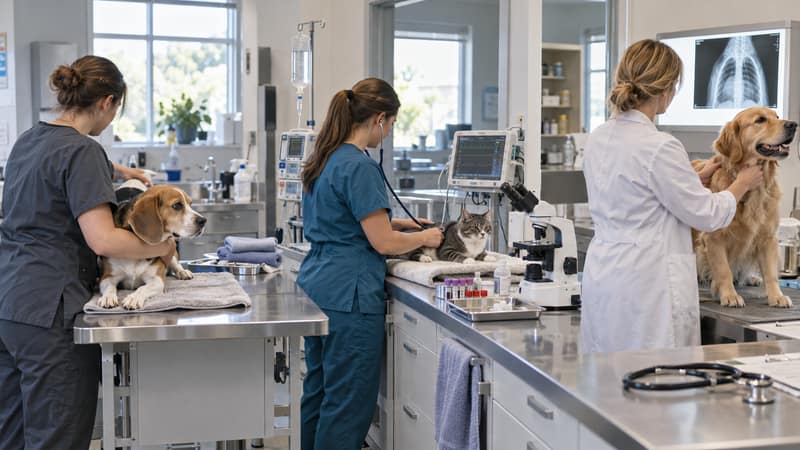 Question answeredVet tech vs vet assistant vs veterinarian: pay, school, dutiesA side-by-side comparison of veterinary assistants, vet techs and veterinarians — education, licensing, daily tasks and BLS May 2025 pay.Read article
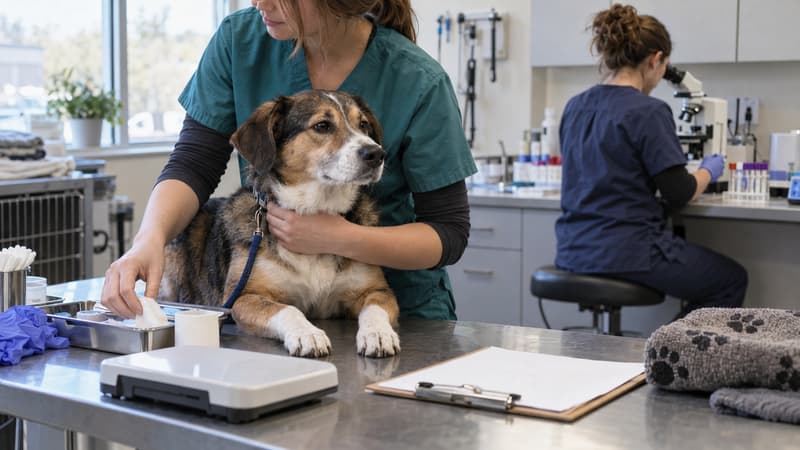 Question answeredVeterinary assistant salary: what the BLS data showsHow much veterinary assistants earn in the U.S. according to the BLS, what moves pay up or down, and how the role compares with vet techs.Read article
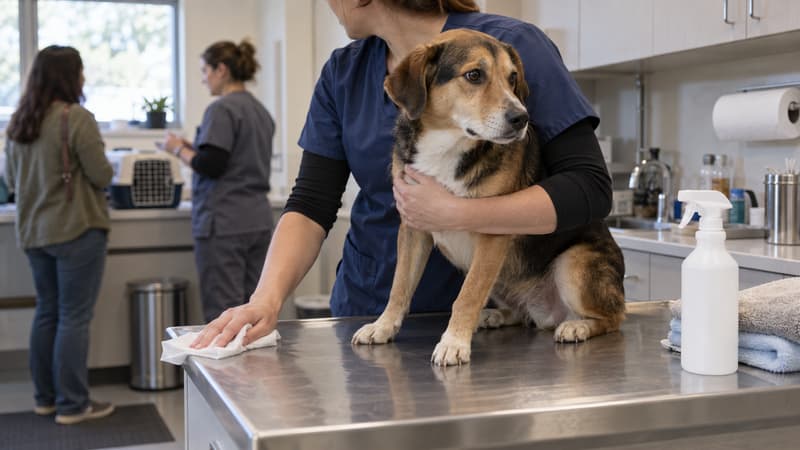 Question answeredWhat does a veterinary assistant do? Daily tasks and limitsA realistic look at a veterinary assistant's day — restraint, cleaning, patient care and client work — and the tasks the role cannot legally do.Read article
Complete topic guide

What a veterinary assistant actually does
A veterinary assistant keeps a clinic running around the veterinarian. Day to day that means greeting clients, restraining animals during exams, cleaning kennels and surgical areas, feeding hospitalized patients and flagging anything that looks off. The O*NET profile for veterinary assistants, maintained by the U.S. Department of Labor, describes the core of the job: holding animals for procedures, monitoring recovery after surgery, keeping areas sanitary and watching for changes in behavior or condition.
Just as important is what an assistant does not do: diagnose, prescribe, induce anesthesia or operate. Those tasks belong to the veterinarian and, under supervision and state rules, to the credentialed veterinary technician.
Assistant, technician and veterinarian at a glance
| Role | Typical education | Main responsibilities | Off-limits |
|---|---|---|---|
| Veterinary assistant | High school diploma, on-the-job training or a short course | Restraint, cleaning, feeding, client care | Diagnosis, prescribing, surgery |
| Veterinary technician | Associate degree plus a state credential in most states | Lab work, anesthesia monitoring, nursing care under supervision | Diagnosis, prescribing, surgery |
| Veterinarian | Doctor of Veterinary Medicine (DVM/VMD) | Diagnosis, treatment, surgery | — |
Pay and outlook
The Bureau of Labor Statistics reports a median pay of $38,150 a year ($18.34 an hour) for veterinary assistants and laboratory animal caretakers in May 2025, with employment projected to grow 9% from 2025 to 2035.
How people get in
Most employers hire at the high school level and train on the job. A structured course is optional but useful: the NAVTA Approved Veterinary Assistant program lists programs that meet a national standard and lead to the AVA designation, which is a good benchmark for judging any course.
How to judge a course
- Supervised externship: how many hours in a real clinic?
- Infection control: cleaning, disinfection, waste handling and zoonoses.
- Low-stress handling: restraint that protects the animal and you.
- Clear scope of practice: a good course explains what you may not do.
- Honest promises: be wary of anyone who guarantees a job or a salary.
The articles below go deeper: daily tasks, how to get hired, assistant vs. technician, pay and whether a course is worth the money.